
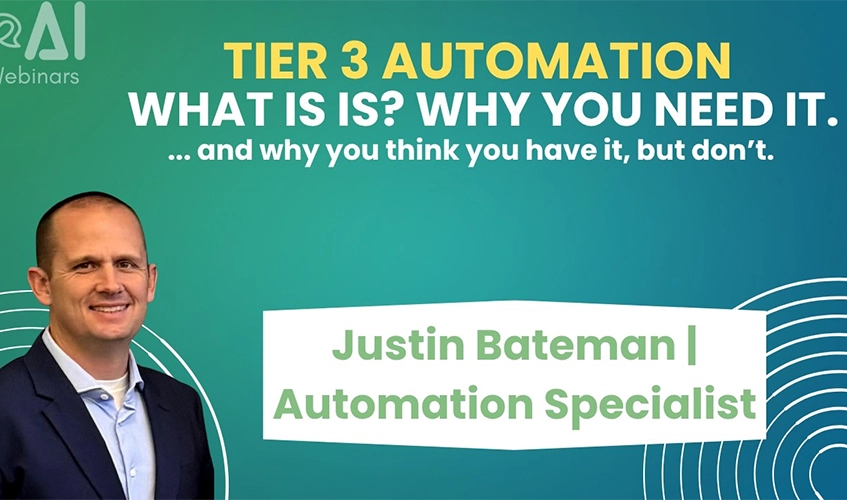
Most practices are running Tier 1 and calling it automation. Here’s what actually separates a reminder system from one that pursues every lead — and where the gap is quietly costing you patients.
Quick Answer:
Automation comes in three tiers. Tier 1 remembers — the appointment, warranty, and birthday reminders your OMS already sends. Tier 2 responds — two-way texting and email layered on top of those reminders. Tier 3 pursues — AI calling and texting agents, intelligent lead funnels, long-term nurture, and patient-recovery campaigns that work nights, weekends, and after hours. Most practices are paying for Tier 1 or Tier 2 and assuming that’s the whole game. The gap between “reminded” and “pursued” is where leads and revenue quietly leak.
Prefer a video? Watch the full webinar here.
If you run or manage a hearing practice, you’ve heard the word “automation” more times than you can count. Your OMS pitches it. Marketing companies promise it. Here’s what I’ve seen after 13 years in the hearing field — as a board-certified hearing instrument specialist in Utah who traveled between clinics, helped open and manage locations, called leads, worked annual due lists, and sat in the PEC seat taking calls — and the last 8 years building marketing automation for practices across the country: most practices aren’t actually automated. They’re just reminded.
There’s a real difference, and it shows up in your revenue, your conversion rates, and how many leads you lose before a human ever picks up the phone. So when an owner tells me “we already have automation — we send stuff through Counselor or Blueprint,” I know exactly what they mean. And most of the time, what they have is a reminder system. Let me show you the three tiers, and where your practice actually falls.
What We’ll Cover
- The three tiers, defined (remember, respond, pursue)
- Tier 1 & Tier 2: what your OMS is actually doing
- Tier 3, Part 1: AI calling agents that ring back in 15 seconds
- Tier 3, Part 2: AI lead funnels and after-hours chat
- Tier 3, Part 3: patient recovery and long-term nurture
- What a full Tier 3 system looks like at scale
- Three numbers every practice owner should know
- Reminders vs. real automation: a side-by-side
- What’s coming next
- Frequently asked questions
The Three Tiers, Defined
I categorize automation into three tiers — and each tier contains the one before it:
- Tier 1 remembers. Scheduled reminders: appointment confirmations, warranty expirations, periodic checkups, birthdays. Your OMS handles this.
- Tier 2 responds. Everything in Tier 1, plus two-way communication — two-way texting and email/SMS campaigns.
- Tier 3 pursues. Everything in Tiers 1 and 2, plus AI calling agents, AI texting agents, intelligent lead funnels, long-term nurture, and patient-recovery automation.
The tell is the question each tier answers. Tier 1 asks, “what reminder do I send?” Tier 3 asks, “what happens to this lead after we capture it — before the appointment, and after it?” The jump from Tier 2 to Tier 3 is the difference between a system that waits and a system that goes after the opportunity.
Tier 1 & Tier 2: What Your OMS Is Actually Doing
Log into Counselor and you’ll see a section labeled “marketing automation” — triggered emails for tested-not-treated, post-fitting, device aging, periodic checkups, birthdays. It’s useful, and I don’t want to knock it. But it’s a reminder engine, not intelligence. Blueprint, Sycle, and newer players like Suno do versions of the same thing, and some add two-way texting — that’s Tier 2, a genuine step up.
Here’s the limit: nothing in Tier 1 or Tier 2 answers the question that actually decides whether a lead becomes a patient — what happens in the minutes and days after someone raises their hand. Are you depending on your team to call them back? Will that happen within an hour, or within seven days? That gap is where Tier 3 lives.
Tier 3, Part 1: AI Calling Agents
This is the core of Tier 3. When someone submits a form on your website, it triggers an AI calling agent to call them back — within about 15 seconds. The goal is to reach the patient while the pain is at its peak. When someone clicks an ad or searches your site, they’re usually looking for a solution right then. Reach them immediately and your odds of scheduling go up.
We set expectations on the confirmation page: “Thanks — get ready to answer your phone. Our AI booking agent will call to get you scheduled.” We tell them plainly that it’s an AI, not a person. And here’s the honest part: roughly 85% of leads don’t answer that first call. But of the leads who do answer, about 85% book an appointment. That’s the trade — you won’t reach everyone in 15 seconds, but the ones you do convert at a remarkable rate, including on a Sunday morning when your team is at church or the beach. You can hear the agent yourself at moretreatments.com.
Tier 3, Part 2: AI Lead Funnels & After-Hours Chat
Alongside the caller, we run lead funnels. A lead comes in — clarity, tinnitus, a book request — and we immediately send a text and an email, notify your team, and ask an open-ended question. If the patient responds, an AI bot can carry the conversation: answer your clinic’s frequently asked questions, explain how you treat tinnitus at your office, and book directly onto the calendar.
The advantage is that it runs at any hour. A tinnitus patient opting in at 2 a.m. gets a real conversation instead of a next-day callback. It also brings the cream to the top: your team calls the people who already booked first, then the people who engaged with questions, then the unresponsive — instead of grinding through 20 cold leads in list order. In some clinics we vet harder, requiring payment for the first appointment before it lands on the calendar. That chat can live inside the funnel, on your website, or on inbound SMS after hours.
Tier 3, Part 3: Patient Recovery & Long-Term Nurture
The last piece is recovery. A Tier 1 system sends a single reminder. A Tier 3 system runs multi-touch campaigns across text and email over weeks, with educational videos and follow-ups. Tested-not-treated three months ago? We text them: “we tested you a few months back — are you still having trouble understanding?” We build those call lists automatically and drip them so responses don’t overwhelm your team — say, 100 messages a day across a 1,000-patient list.
The principle is simple: unless you’ve truly broken the relationship, you keep communicating until the patient tells you to stop. One “no” isn’t a permanent no. Most of these people just weren’t ready yet — and staying top of mind is what brings them back.
What a Full Tier 3 System Looks Like at Scale
People underestimate how much runs under the hood. A single-location practice on a full Tier 3 system has roughly 100 active campaigns — patient communication, lead communication, reporting, administrative workflows, tested-not-treated and cancels, and special events. A large multi-location group I work with is running 454 active campaigns. Most of those aren’t patient-facing texts; a lot of them are the logic that keeps the phones and the PEC seat efficient.
Roughly, the mix breaks down to about 25% current-patient communication, 20% lead communication, and around 10% each for administrative, reporting, tested-not-treated/cancels, and special events. You don’t have to manage any of that yourself — that’s the point — but it’s worth seeing how much a real system is doing in the background.
Three Numbers Every Practice Owner Should Know
Industry data suggests leads contacted within 5 minutes can be up to 20 times more likely to convert than those reached later. An AI agent can call in about 15 seconds — almost no front desk can.
Share of leads who answer our newest AI agent’s call and go on to book. The catch: most don’t answer the first call, which is why we prep them to expect it.
Revenue from one client’s two-week reactivation campaign to ~3,300 lapsed patients — about 41 opt-ins and 23 booked appointments. Results vary.
Reminders vs. Real Automation: A Side-by-Side
|
What Happens |
Tier 1 / Tier 2 (Basic OMS) |
Tier 3 (Audiology Intelligence) |
| Lead response | Manual callback, often hours later | AI agent calls within ~15 seconds |
| After-hours coverage | None | AI chat and calling, nights and weekends |
| Lead follow-up | One or two attempts | Branching funnel over 7–10 days |
| Old / lapsed patients | Occasional reminder | Automated recovery and reactivation campaigns |
| Call lists | Pulled and printed by hand | Built automatically, prioritized “cream to the top” |
| Your team’s role | Chase every lead | Work a prioritized list — the system does the chasing |
What’s Coming Next
A few things on the roadmap — dates are targets, not promises. In Q3 we’re rolling out a new automated reporting dashboard for Tier 3 clients: revenue, spend, ROI, cost-per-lead, and booked appointments by channel, pulled automatically so you’re not filling in a Google Sheet by hand. We’re also adding landing-page retargeting and immediate Facebook and Instagram messaging for Meta leads, plus OMS sync for Counselor and Suno (alongside Blueprint and Sycle) so your data lives in one place.
And the bigger project: in 2027 we plan to launch our own OMS — we’re calling it Treatment Flow AI OMS for now — integrating with NOAH so hearing-evaluation data flows straight into the patient communication schedule and back. It’s early, but it’s the direction we’re building toward.
The Real Question: Reminded, or Pursued?
It comes down to one choice. Do you want a Tier 3 system that engages leads instantly, calls your annual-due list automatically, and converts more patients while saving your team time? Or are you fine with a Tier 1 system that just sends reminders? For most owners I talk to, the answer is obvious once they see the gap.
This isn’t about removing the human touch. We still want your team talking to patients — that’s where trust is built. It’s about getting through names faster and booking people before they go somewhere else. If you’re not sure which tier you’re on, that’s worth a conversation. Try the AI agent yourself at moretreatments.com, request a demo, or email me directly at justin@audiology-intelligence.mystagingwebsite.com and we’ll map it to your practice.
About the Author

Justin Bateman
Director & Automation Specialist, Audiology Intelligence
Justin has spent more than a decade in the hearing industry. He began as a Board Certified Hearing Instrument Specialist working directly with patients — traveling between clinics, helping open and manage locations, and working the phones and the PEC seat — before moving full time into marketing automation, which he has now been building for eight years. He holds a Master of Public Administration from Southern Utah University. At Audiology Intelligence, he leads automation strategy and builds the Treatment Flow system for private practices nationwide.
Frequently Asked Questions
What’s the difference between Tier 1, Tier 2, and Tier 3 automation?
Tier 1 remembers — scheduled reminders like appointment confirmations and warranty alerts. Tier 2 responds — it adds two-way texting and email. Tier 3 pursues — AI calling and texting agents, intelligent lead funnels, long-term nurture, and automated patient-recovery campaigns that run around the clock. Each tier includes the ones below it.
Doesn’t my OMS (Counselor, Blueprint, Sycle) already do this?
Your OMS handles scheduling and reminders well, and some add two-way texting, which puts you at Tier 2. What they generally don’t do is AI-powered instant lead response, branching lead funnels, segmented long-term nurture, or automated reactivation campaigns — that’s the Tier 3 layer we build on top.
Do I have to switch my website or ads to Audiology Intelligence to use this?
Does AI automation replace my staff?
No. It removes the busywork — chasing lead lists, pulling and printing call lists, remembering every follow-up — so your team can spend their time on the conversations that actually convert. Humans still do the human part; the system just makes them far more efficient.
What kind of results can a reactivation campaign produce?
Results vary by practice, market, and how consistently your team works the lists. As one example, a client’s two-week campaign to about 3,300 lapsed patients generated roughly $80,000 in revenue. Some practices run these two or three times a year.